safety

Neighborhood · Unincorporated community (CDP)
Backcountry wine, horse property and a main street that has nothing to do with the coast.
Population
Median home value
Aug high / Jan low
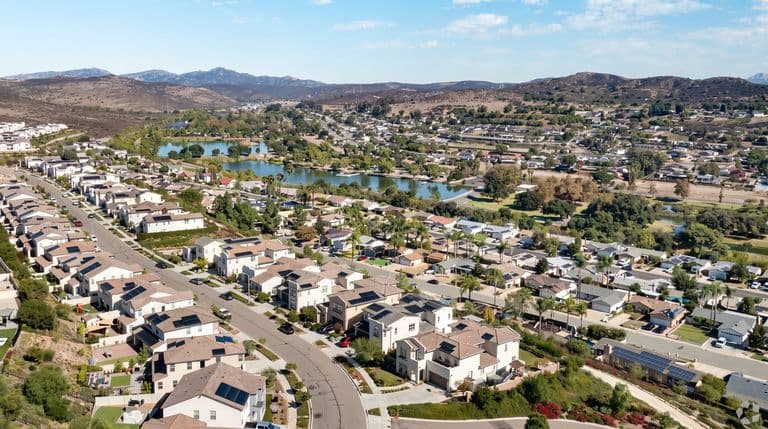
Ramona is an unincorporated backcountry town of about 21,500 people in its census-designated place, spread across a high valley at roughly 1,400 feet between Poway and Julian. The town was first called Nuevo; in 1886 a land syndicate headed by Milton Santee renamed it after Helen Hunt Jackson's novel Ramona, which had made Southern California romance fashionable. The name briefly reverted before becoming permanent in 1894. Agriculture has always defined the valley. In the 1930s Ramona promoted itself as the Turkey Capital of the World, then built a large egg industry that lasted into the 1970s. Today grapes are the signature crop: the 89,000-acre Ramona Valley became an American Viticultural Area in 2006, and dozens of small wineries and tasting rooms dot the hills. Main Street keeps a working-town feel, with feed stores and diners near the 1886 Verlaque adobe that houses the Ramona Heritage Museum, also known as the Guy B. Woodward Museum. Most residents live on large lots, from half-acre parcels near town to horse ranches and the San Diego Country Estates subdivision to the southeast, all served by Ramona Unified School District. The Ramona Rodeo and Ramona Country Fair anchor the summer calendar, and the Ramona Grasslands preserve protects open land prized by birders. Living here means long drives on SR-67 or SR-78 to jobs and shopping, wide daily temperature swings, and a place in some of the county's most fire-prone country.
Draws
Tradeoffs
Good for: People who want genuinely rural living, animals or wine country in San Diego County and are willing to drive for work.
Ramona's high inland valley has one of the widest daily temperature swings in the county, averaging about 30 degrees between afternoon highs and overnight lows. Summers are hot, with a record of 117 degrees in July 2018, while winter nights can fall well below freezing; the record low is 16 degrees. The marine layer rarely reaches the valley, and Santa Ana winds bring extreme fire weather in fall.
Aug avg high
Jan avg low
Annual rain
Best time to visit: Spring for green grasslands and winery visits in mild weather, or late summer for the Ramona Country Fair and Rodeo if you can handle the heat.
Typical home value $779,576 (-1.3% year over year)
Mostly single-family homes on large rural lots, including ranches, horse properties and vineyard parcels, with older small homes near Main Street and planned-community houses in San Diego Country Estates.
Freeways: SR-67, SR-78
Transit: No trolley or rail; transit options are limited and nearly all residents drive.
Parking: Free parking is easy on and around Main Street except during rodeo and fair weekends.
Walkability: Redfin gives Ramona a Walk Score of 32; only the Main Street core is practical on foot.
Ramona is a strong fit for buyers who want acreage, horses and a small-town culture, with a Redfin median sale price near $780,000. It is car-dependent with a Walk Score of 32, has long commutes and faces serious wildfire risk.
Redfin reported a median sale price of $779,576 over the three months through June 2026, down 1.3% from a year earlier. Ranch and vineyard properties can sell far above that.
NOAA 1991-2020 normals at Ramona Airport show August highs around 93 degrees with lows near 64, and January highs around 64 with lows near 41. Rainfall averages about 10.8 inches a year.
Ramona is known for its wine country, the Ramona Rodeo and Country Fair, its ranching heritage and its history as the self-described Turkey Capital of the World.
The Ramona Valley AVA, established in 2006, covers 89,000 acres and holds dozens of small wineries; Tripadvisor lists 27 wineries and vineyards in the Ramona area.