safety

Neighborhood · City of San Diego neighborhood
The original settlement, now a state park and a tourist corridor, with the county archives and some genuinely good Mexican food.
Aug high / Jan low
Old Town is where the city of San Diego began. The Kumeyaay village of Kosa'aay stood near the mouth of the San Diego River before Spain founded a presidio and mission on the hill above in 1769, and the adobe town that grew at the base of that hill in the 1820s received pueblo status from Mexico in 1834. When Alonzo Horton promoted his New Town on the bay in the 1860s, commerce drifted south, and the county government followed in 1871. What remains is compact: the community planning area covers about 230 acres between Interstate 8, Interstate 5 and the Mission Hills slope. Old Town San Diego State Historic Park, created in 1968, preserves five original adobes and a set of reconstructed buildings interpreting the 1821 to 1872 period, including Casa de Estudillo, the Mason Street School and the Seeley Stables. California State Parks listed it as the most visited state park in California in 2005 and 2006. San Diego Avenue and the Fiesta de Reyes courtyard supply the Mexican restaurants, tequila bars and souvenir shops that most visitors come for, and the Whaley House draws a steady stream of ghost-tour customers. Few people actually live here. Housing is a thin band of older cottages, small apartment buildings and condos on the streets climbing toward Mission Hills, and Redfin showed only three homes for sale in its most recent snapshot. The bigger shift is transit: the Old Town Transit Center links the Blue and Green trolley lines, the Coaster and Amtrak's Pacific Surfliner, making the neighborhood one of the region's busiest transfer points.
California's 'birthplace' — preserved and reconstructed 1800s buildings, living-history museums and Mexican restaurants. Free to wander.
An 1857 Greek Revival home billed as one of America's most haunted — daytime history tours and evening ghost tours.
Draws
Tradeoffs
Good for: Transit commuters and history-minded renters or buyers who don't mind living inside a visitor district.
Old Town sits near the mouth of the San Diego River a couple of miles from Lindbergh Field, so it shares the airport's mild, marine-influenced climate. Morning low clouds are common from May through early July, and the river flat can be a few degrees cooler at night than the hillsides above.
Aug avg high
Jan avg low
Annual rain
Best time to visit: Visit in September through November for warm, clear afternoons, the October art and tequila events and Dia de los Muertos.
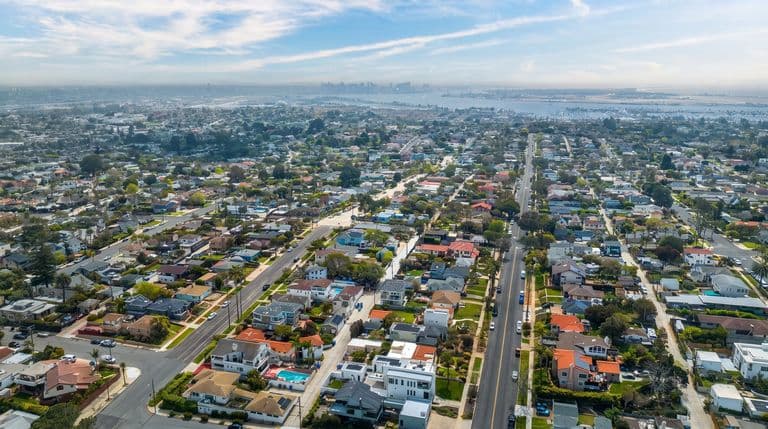
A small stock of older one- and two-bedroom cottages, modest apartment buildings and hillside condos, many with bay or airport views; Redfin's latest snapshot showed three listings priced from $599,000 to $1,495,000.
Freeways: I-5, I-8
Transit: Old Town Transit Center serves the Blue and Green trolley lines, Coaster commuter rail, Amtrak Pacific Surfliner and multiple MTS bus routes.
Parking: The state park offers free lots with a four-hour limit (EV chargers in Lot B), but they fill on weekends and event days.
Walkability: The historic core is flat and compact enough to see on foot in an afternoon, though I-5 and I-8 cut it off from neighboring areas.
It suits people who prioritize transit and central location: the Old Town Transit Center links trolley, Coaster and Amtrak service. The tradeoff is a tiny housing stock, tourist traffic and freeway noise.
There is no reliable typical value because so few homes sell; Redfin's snapshot showed three listings between $599,000 and $1,495,000. Buyers usually compare with adjacent Mission Hills and Bay Park.
Old Town shares Lindbergh Field's coastal climate: about 66.4°F January highs, 77.3°F August highs and 9.79 inches of rain a year. May and June mornings are often overcast.
It is the birthplace of San Diego, with the 1769 presidio site, a state historic park created in 1968, the Whaley House and a cluster of Mexican restaurants.
Yes, the park's lots are free for up to four hours, and Lot B has EV chargers. On busy days, arriving by trolley or Coaster at the adjacent transit center is easier.