food

Neighborhood · Incorporated city
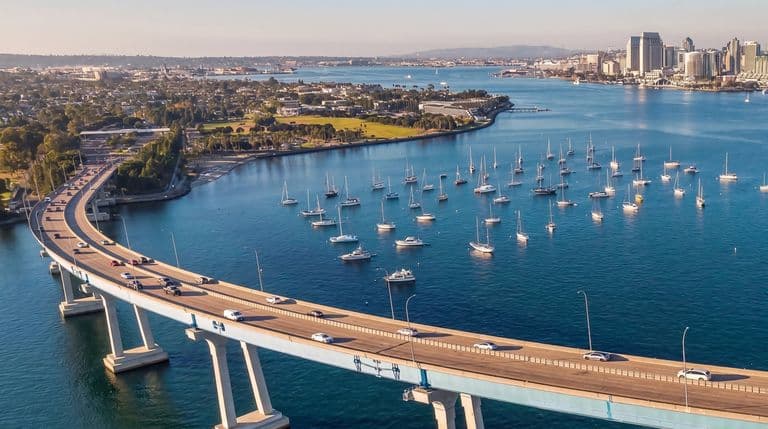
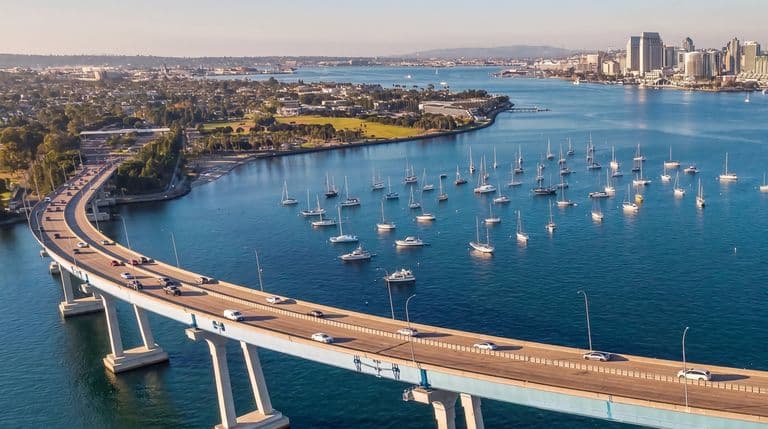
An island that is not one. The Hotel Del, a Navy air station, and the bridge that defines the skyline from downtown.
Population
Median home value
Aug high / Jan low
To downtown
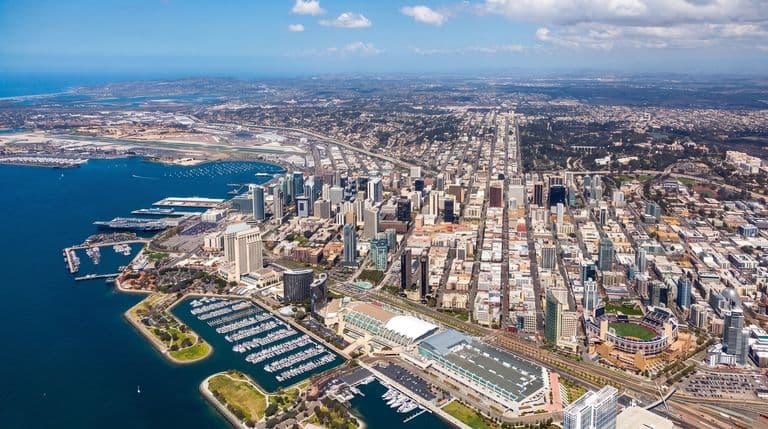
Coronado is a separate city of about 21,000 people across the bay from downtown San Diego, set on a tied island joined to the mainland by the Silver Strand and, since 1969, by the San Diego-Coronado Bridge. Elisha Babcock and Hampton Story bought the land in 1885 and opened the Hotel del Coronado in February 1888 to sell lots in their new resort town; the city incorporated in 1890. Two institutions still define it. The Hotel del Coronado, a National Historic Landmark and the second-largest wooden building in the country, finished a $550 million restoration of its Victorian main building in 2025. Naval Air Station North Island, where Glenn Curtiss opened a flying school in 1911, covers the island's northern half and makes the Navy Coronado's largest employer; Naval Amphibious Base and the SEAL training beaches line the Strand to the south. The civilian village between them is a grid of tree-lined streets, historic cottages and large beachfront homes centered on Orange Avenue, where residents walk or bike to school, the library and the beach. It is one of the most expensive housing markets in the county, with a typical home value above $2.5 million, and it has a small-town civic calendar built around a Fourth of July parade. Coronado is also changing: in June 2026 North Island hosted NASCAR's first Coronado street-course race to mark the Navy's 250th birthday.
Draws
Tradeoffs
Good for: Families and Navy households who can afford a premium for a walkable, self-contained beach town.
Lindbergh Field sits just across the bay, and Coronado's surrounding water keeps its temperatures in the same narrow range. The ocean-facing beach is often cooler and foggier than the bay side in May and June. Winter days are frequently clear, with snow visible on distant peaks after storms.
Aug avg high
Jan avg low
Annual rain
Best time to visit: September and October for warm, clear beach weather, or early July for the town's Fourth of July celebration.
Typical home value $2,550,024 (+6.1% year over year) · median rent $3,257
Historic cottages, Craftsman and Spanish Revival homes on the village grid, large estates along Ocean Boulevard, and condo towers on the Coronado Shores stretch of the Strand; military families also occupy Navy housing.
Freeways: SR-75, I-5
Transit: MTS Route 901 runs between downtown San Diego, Coronado and Imperial Beach, and ferries cross from downtown's Broadway Pier and Convention Center to the Coronado Ferry Landing.
Parking: Metered and time-limited parking on Orange Avenue and near the beach; Navy commute traffic crowds the bridge and Third and Fourth streets at shift changes.
Walkability: The village is flat and compact, and most residents walk or bike to shops, schools and the beach.
For households that can afford it, Coronado offers a walkable village, its own unified school district and a wide beach, with about 21,000 residents. Trade-offs include very high prices, military air traffic and bottlenecks on the bridge and Strand.
Zillow's typical home value for Coronado was $2,550,024 as of July 2026, up 6.1% year over year. The Census Bureau's 2020-2024 median owner-occupied value is top-coded at $2 million-plus.
Mild and marine. At nearby Lindbergh Field, January highs average about 66 degrees and August highs about 77, with roughly 9.8 inches of rain a year. May and June are often gray at the beach.
The 1888 Hotel del Coronado, its wide sandy beach, Naval Air Station North Island and Navy SEAL training, and one of the region's best-known Fourth of July celebrations.
Not technically. It is a tied island connected to the mainland by the Silver Strand, a narrow sand spit that runs south to Imperial Beach. Most visitors arrive via the 1969 San Diego-Coronado Bridge or the ferry.